Every value-based care program has the same question hidden behind its contract: Are we detecting clinical deterioration early enough to avoid subsequent readmissions, ER visits, or quality penalties? Remote patient monitoring is often thought to be the answer, but most teams still struggle to know whether RPM truly delivers measurable results in a real VBC environment.
Evidence says it can happen. Studies of ACO rates have shown significant reductions in mortality rates.
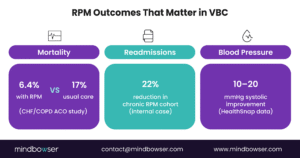
The RPM Hypertension Program has demonstrated a reduction in systolic blood pressure of 10-20 mmHg in high-risk patients. Similar in-house chronic care RPM cases with TodayHealth have resulted in double-digit readmission reductions. This is not a technology story. It’s a contract performance story.
The problem is not whether RPM works in theory. The problem is designing an RPM program that works for your group, your caregivers, and your specific VBC incentives. This guide reviews the strongest research, outlines ROI and sensitivity models, and provides a ready-to-implement chronic bundle template that fits directly into value-based contracts.
I. What problems does RPM actually solve in value-based care?
Value-based caring leaders don’t need another gadget. They need a proven way to stabilize high-risk patients between visits. RPM is useful when providing:
- Reduces avoidable readmissions resulting in joint HRRP and ACO savings.
- Improved control of blood pressure, diabetes, and cardiometabolic risk.
- Clear documentation that can stand up to a CMS or OIG audit.
- Workflows that protect caregiver bandwidth, not expand it.
CMS defines RPM as medication management using patient-generated physiological data from connected devices that meet regulatory standards, billed under codes such as 99453, 99454, 99457, and 99458. This is not simple patient outreach.
This is a regulated clinical service that requires documentation of medical necessity, valid data, and physician review.
For this to work in VBC, RPM must be directly connected to maintenance management and digital quality measurement workflows. Accelerators like AI Medical Summary, HealthConnect CoPilot, and WearConnect help integrate RPM flows into EHR workflows without creating another silo.
II. What does the evidence actually show about RPM results?
A. Decrease in mortality and readmission rates
A large ACO study of post-hospitalization remote monitoring for CHF and COPD reported a six-month mortality rate of six point four percent in the RPM group compared with seventeen percent in the usual care group.
This includes an adjusted odds ratio of 0.41. This has a major clinical impact on the population driving contract costs.
Internal chronic care RPM results showed a 22% reduction in complex patient readmissions. If your organization manages even a few hundred high-risk patients, a reduction like this could change the HRRP penalty or shared savings.
B. Hypertension and cardiometabolic outcomes
HealthSnap reports an average systolic blood pressure increase of about 10 millimeters in the general hypertensive RPM population and approaching 20 millimeters in Stage 2 hypertension.
A separate multi-site asynchronous monitoring study with more than 2,700 patients demonstrated significant improvements in systolic and diastolic readings across cardiology and primary care groups.
These findings align directly with Stars and HEDIS measures for blood pressure control that impact Medicare Advantage payments.
C. Early detection and safety signals
That Monash Health Evidence Check summarized several remote monitoring studies in which damage detection reduced mortality or readmission rates among high-risk populations. A large system using continuous predictive monitoring prevents hundreds of deaths per year by eliciting early instability.
For implementation teams, the takeaway is simple. The value is not in data collection. Its value is that it enables faster action. This is where accelerators like AI Readmission Risk and RPMCheck AI help teams prioritize who needs attention right now.
PakarPBN
A Private Blog Network (PBN) is a collection of websites that are controlled by a single individual or organization and used primarily to build backlinks to a “money site” in order to influence its ranking in search engines such as Google. The core idea behind a PBN is based on the importance of backlinks in Google’s ranking algorithm. Since Google views backlinks as signals of authority and trust, some website owners attempt to artificially create these signals through a controlled network of sites.
In a typical PBN setup, the owner acquires expired or aged domains that already have existing authority, backlinks, and history. These domains are rebuilt with new content and hosted separately, often using different IP addresses, hosting providers, themes, and ownership details to make them appear unrelated. Within the content published on these sites, links are strategically placed that point to the main website the owner wants to rank higher. By doing this, the owner attempts to pass link equity (also known as “link juice”) from the PBN sites to the target website.
The purpose of a PBN is to give the impression that the target website is naturally earning links from multiple independent sources. If done effectively, this can temporarily improve keyword rankings, increase organic visibility, and drive more traffic from search results.