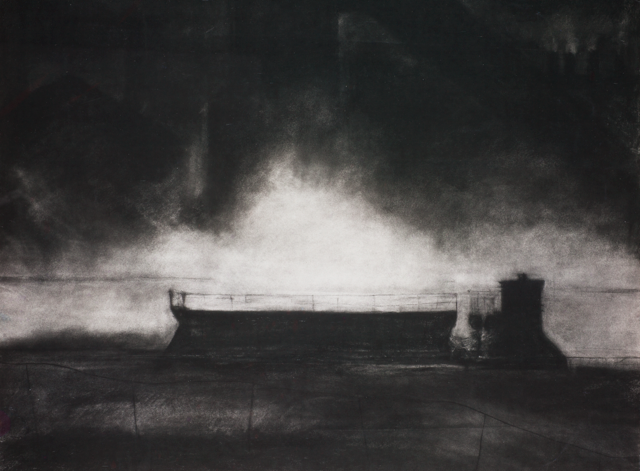
Drawing by Turner Brooks.
I first became aware of the existence of a coke factory in New Haven, Connecticut, when, one evening, I looked out from the roof of the Yale architecture school and saw a huge cloud of steam in the distance—so thick that one could climb into it—somewhere near the harbor. After a while, I realized that the clouds appeared at intervals of almost forty-five minutes. I cycled to the harbor and saw its source on the far shore: a giant black figure rising from the yellow marsh grass into a stunning configuration of towers connected by diagonal passageways, all raised high on spindly steel columns and cross-braces that looked like the graceful legs of a giant praying mantis.
Burping steam was coming out from somewhere inside. I made some long distance pictures. I was in my first year of architecture school, in 1966, and this building was an industrial coke production site. Then, under the cover of night, I crossed the harbor bridge. There are no gates or fences surrounding the complex. I found my way in, and I was quickly immersed in the most time-consuming physical environment I had ever experienced. I walked through it, first passing some warehouses. Among them were incomprehensible contraptions that looked like giant robots, working to what I slowly understood was a set rhythm, moving coal and coke, apparently independent of human intervention. This equipment clanks, rattles and squeaks loudly. A burst of steam erupted unexpectedly from an underground source. Inside the warehouse built on the railroad tracks, one can hear a rattling sound, which increases to a roar, as coal and coke are loaded into large steel vats.
Towards the coast there is a vast expanse of coal mountains, illuminated by a light mist. A huge double-frame gantry crane, supported some sixty feet above by two vertical steel truss towers, spanned a hundred-yard-wide coal field, gliding along the roughly quarter-mile-long field over the railroad tracks on each side. A large bucket dropped the coal coming from the barge onto the beach in a pile. The same bucket recovers coal to be fed into the chute, and from there the coal is emptied onto a conveyor belt and distributed to ovens to be burned into coke. The gantry looks like another kind of giant, weird animated insect. In the distance, on the shore, another crane hovers over a barge in the harbor containing incoming coal.
The Coke Factory represents for me, with incredible power, the embrace of darkness and shadow. Everything I could see around me while I was there was darker than night, until suddenly, around a corner, there would be a raging ball of fire and smoke, shadows flickering everywhere, and then, moments later, a thick, expanding mass of steam drifted up into the sky in the shape of a twisted, glowing mushroom. The fire came from the emptying of one of one hundred and seventy ovens, aligned side by side, where coal was burned and turned into coke. Just as charcoal burns hotter than wood, coke also burns hotter than coal, so coke is better used in steel mills—its ultimate goal.
The structure holding the oven is the centerpiece of the complex. Each oven was about seventy-five feet deep, two feet wide, and eighteen feet high. An additional insect-like mechanism slides on rails across the sides of the oven to open doors at either end of the oven for emptying at the end of the firing process. Then a steel battering ram slid into place. The arm fits the section of the oven, as well as its length, and pushes the coal that has now burned into coke through it and out the other end. At the same time, a small electric engine drives the so-called “hot car” along a track that runs below and parallel to the oven. The scene unfolds as a mass of white hot coke emerges from the oven, momentarily maintaining a rectangular shape as it floats about ten feet into space, before slowly disintegrating and then crashing into a mass of flames and sparks. The hot car moves slowly along the rails beneath it, absorbing the entire volume released from the oven. It then continued its journey several hundred feet down, its charge glowing and pulsing and lighting up the landscape around it. The road passes under a domed brick structure topped by a huge water reservoir. The water was released all at once into the coke in a dramatic final cooling process, causing a tremendous, tremendous hissing sound, and releasing a giant cloud of steam that had drawn me into the coke plant. As soon as the coke was emptied from the oven, another machine rotating on rails poured new coal through the roof portal to refill it. It is then quickly sealed for another round of firing. The process never stops; it lasts twenty-four hours a day.
Once the coke cooled, it flowed down a conveyor belt, over another shaft track, and was dropped into cars pushed or pulled by small, smoke-spewing steam locomotives that passed through the complex onto the main railroad that would transport the coke to the Bethlehem Steel plant in Pennsylvania.
During my nighttime visits to the coke factory, I continued to make pictures. In the dark, the atmosphere of the place dominates each object. In a way, it becomes like a giant interior stage located on that miserable coastline. The curtain rises at dusk. When the sunlight dies, so does the rest of the world, and a smoky, sizzling drama of fire and steam takes over.
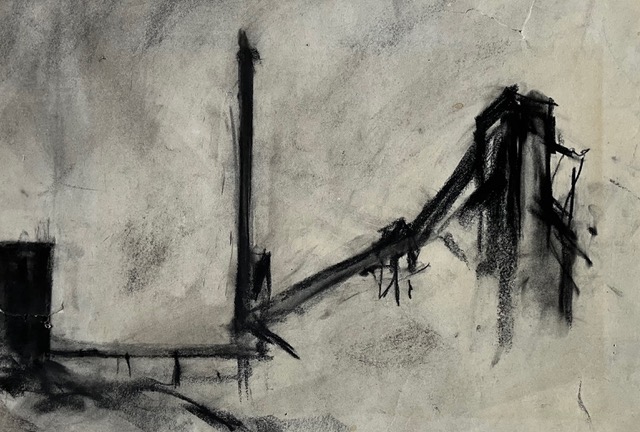
Drawing by Turner Brooks.
At first, the only sign of human life I saw was an arm sticking out of the cab of one of the moving contraptions, or the silhouette of a head near fire or steam. But during my constant nightly visits, I gradually got to know the owners of these arms and heads, and they kindly allowed me to join them in the cabins of the various machines they operated. I was invited into the cab of a gantry crane hovering over an entire coal field, and—most interestingly—into the small engine that pushed a “hot car” full of burning coke down the dowser. The workers didn’t ask many questions and referred to me, pleasantly, as a “Russian spy” who was stealing American technological secrets through his sketchy drawings. In the second year of my acquaintance with the coke plant, I began to look at the dates JULY 7 written in white chalk on many black steel walls. I learned that this was the coke factory’s last day of operation. The year was 1968. New Haven had brought in a natural gas pipeline from Texas that replaced the gas supplied to the city as a byproduct of burning coke. The coke factory will close.
I came to the factory at the end of the day on July 7 and stayed all night. There may have been a miscalculation: there was more coal than the workers expected, which still needed to be burned into coke. Suddenly, in the afternoon, the oven filling and emptying and dowsing all started to go much faster. Early in the morning, the last of the coke was poured. After the oven is emptied for the final time, the hole in the roof of the oven for loading new coal is left open, and whatever remains in the oven is burned into the atmosphere. The sky was filled with sparks and steam. The steam reflected off the open embers and glowed in a vast orange haze that enveloped the entire place. It was an apocalyptic ending; the sky above looks like the charged atmosphere in a JMW Turner painting. When the sun rose, everything was quiet, except for a slight hissing sound.
From Spatial Memories and Preoccupations of an Architect, coming out this August from NYRB.
Turner Brooks is the principal Turner Brooks Architect, based in New Haven.
News
Berita Teknologi
Berita Olahraga
Sports news
sports
Motivation
football prediction
technology
Berita Technologi
Berita Terkini
Tempat Wisata
News Flash
Football
Gaming
Game News
Gamers
Jasa Artikel
Jasa Backlink
Agen234
Agen234
Agen234
Resep
Download Film
Gaming center adalah sebuah tempat atau fasilitas yang menyediakan berbagai perangkat dan layanan untuk bermain video game, baik di PC, konsol, maupun mesin arcade. Gaming center ini bisa dikunjungi oleh siapa saja yang ingin bermain game secara individu atau bersama teman-teman. Beberapa gaming center juga sering digunakan sebagai lokasi turnamen game atau esports.