
What to Check in Your Platform Before December 31, 2026
We built a HIPAA-compliant telemedicine platform end-to-end in 21 days for a client earlier this year, full video, scheduling, and e-prescribing stack from a blank repo. The fastest part of that build was the video layer. The part that actually took the time was the prescribing-compliance logic, because compliance logic doesn’t fail loudly. It fails quietly, three months later, when an auditor pulls a sample.
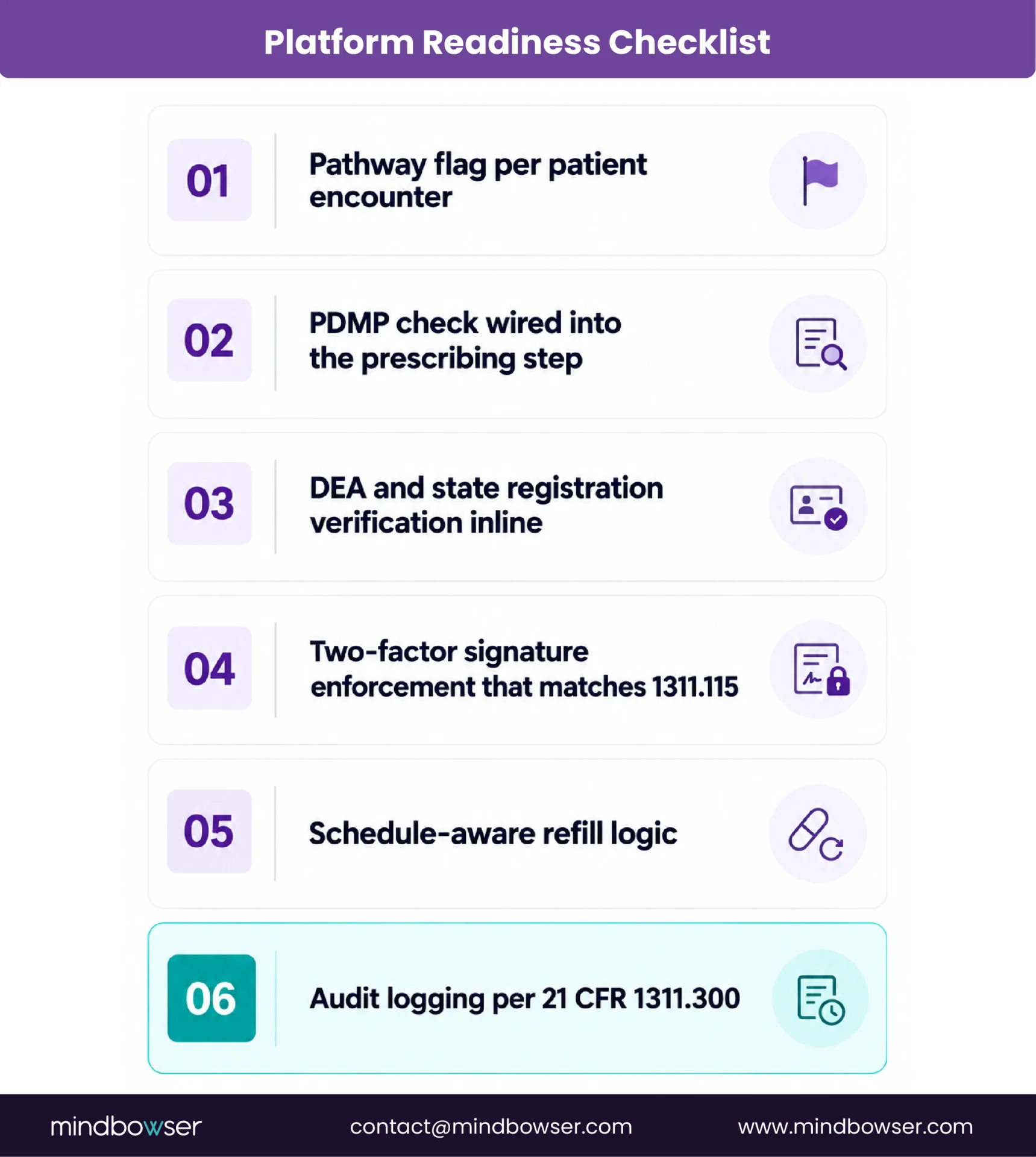
Here’s the checklist we’d run against any telemedicine platform right now, regardless of which direction the special registration rule goes.
- Pathway flag per patient encounter. Does the system know, at the point of prescribing, whether this encounter falls under the general flexibility, the buprenorphine/MOUD pathway, or neither? Most platforms we’ve audited track “controlled substance: yes/no.” Almost none track which of the three pathways applies.
- PDMP check wired into the prescribing step, not a separate manual lookup. State prescription drug monitoring program checks are mandatory in most states before controlled substance prescriptions; bolting this on as a side process is where it gets skipped under time pressure.
- DEA and state registration verification inline, checked against the prescribing provider’s actual state of licensure for that encounter, not just their home state.
- Two-factor signature enforcement that matches 1311.115, not generic app-level 2FA. If your e-prescribe step and your login step share the same auth logic, check whether that logic actually satisfies the factor-type requirement.
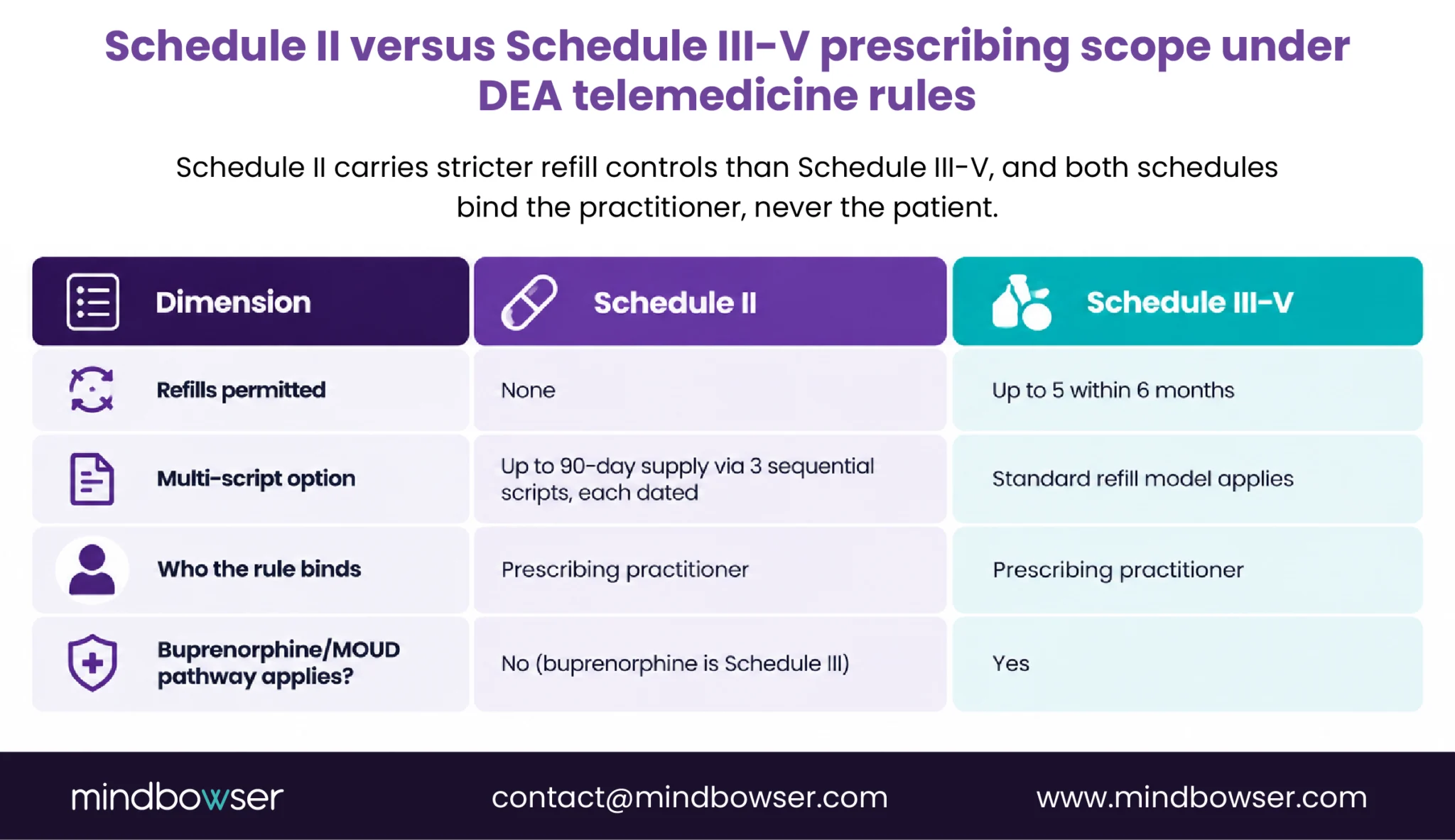
- Schedule-aware refill logic. Separate rule paths for Schedule II (no refills, 90-day multi-script with earliest-fill dates) versus III-V (refills allowed, capped).
- Audit logging per 21 CFR 1311.300, with records retained and reviewable, not just a database row with no export path.
What Happens if the Special Registration Rule Publishes Before December 31, and What Happens if It Doesn’t
Nobody on page one of this topic actually walks through both branches. We will, because both are live possibilities right now.
If the special registration rule publishes before December 31: the temporary extension’s deadline becomes moot, but only for platforms that have actually read the new rule’s requirements, which based on the 2025 proposal would likely include separate registration categories for general telemedicine prescribing, a more permissive track for specialties like psychiatry and hospice, and a telemedicine-platform-level registration distinct from the individual practitioner’s DEA number.
If your platform architecture assumes one registration model, you’d need to rebuild part of your onboarding and verification flow fast, inside whatever transition window the final rule allows.
If it doesn’t publish in time: DEA has extended this flexibility four times already, each time before the prior deadline hit. We’d bet on a fifth extension over a hard cliff into the pre-2020 Ryan Haight requirements, which would functionally end audio-video-only controlled substance prescribing for most telehealth-first practices overnight. That said, we’ve been wrong about regulatory timelines before, and “they always extend it” is a pattern, not a guarantee.
Either way, the checklist above holds. Pathway-flagging, PDMP integration, and audit logging aren’t deadline-specific fixes. They’re the foundation any version of this rule, temporary or permanent, is going to require.
Schedule II vs. III-V, and Who the Rule Actually Binds
One scope question we get asked constantly, often by people who’ve read three client alerts and are still unsure: does this rule reach the patient, or the practitioner?
It binds the prescribing practitioner, not the patient. A patient receiving a telemedicine prescription has no DEA compliance obligation. The burden, identity proofing, two-factor authentication, PDMP checks, registration verification, sits entirely on the prescriber and, by extension, on the platform that routes their prescribing workflow. We’ve seen more than one scope-confusion case in this space resolve exactly backward, where a team spent weeks building patient-facing consent flows for a rule that never touched the patient side at all.
If your practice touches telepsychiatry or any behavioral-health prescribing specifically, the scope questions get more layered; state licensing compacts like PSYPACT interact with the federal rules here in ways that deserve their own treatment. We covered the EPCS and multistate licensing readiness checklist for telepsychiatry platforms separately, and it’s worth reading alongside this piece if that’s your specialty.
If telepsychiatry is where most of your prescribing volume actually lives, the two pieces together cover more of your real compliance surface than either one alone.
And if the HIPAA side of your architecture, not just the DEA side, is the thing you’re least sure about, our breakdown of HIPAA-compliant telehealth platform requirements is the natural next read. For behavioral-health-specific HIPAA questions, HIPAA rules for behavioral health telehealth go deeper into 42 CFR Part 2’s overlay with HIPAA, which matters more in this specialty than almost anywhere else in telehealth.
PakarPBN
A Private Blog Network (PBN) is a collection of websites that are controlled by a single individual or organization and used primarily to build backlinks to a “money site” in order to influence its ranking in search engines such as Google. The core idea behind a PBN is based on the importance of backlinks in Google’s ranking algorithm. Since Google views backlinks as signals of authority and trust, some website owners attempt to artificially create these signals through a controlled network of sites.
In a typical PBN setup, the owner acquires expired or aged domains that already have existing authority, backlinks, and history. These domains are rebuilt with new content and hosted separately, often using different IP addresses, hosting providers, themes, and ownership details to make them appear unrelated. Within the content published on these sites, links are strategically placed that point to the main website the owner wants to rank higher. By doing this, the owner attempts to pass link equity (also known as “link juice”) from the PBN sites to the target website.
The purpose of a PBN is to give the impression that the target website is naturally earning links from multiple independent sources. If done effectively, this can temporarily improve keyword rankings, increase organic visibility, and drive more traffic from search results.

