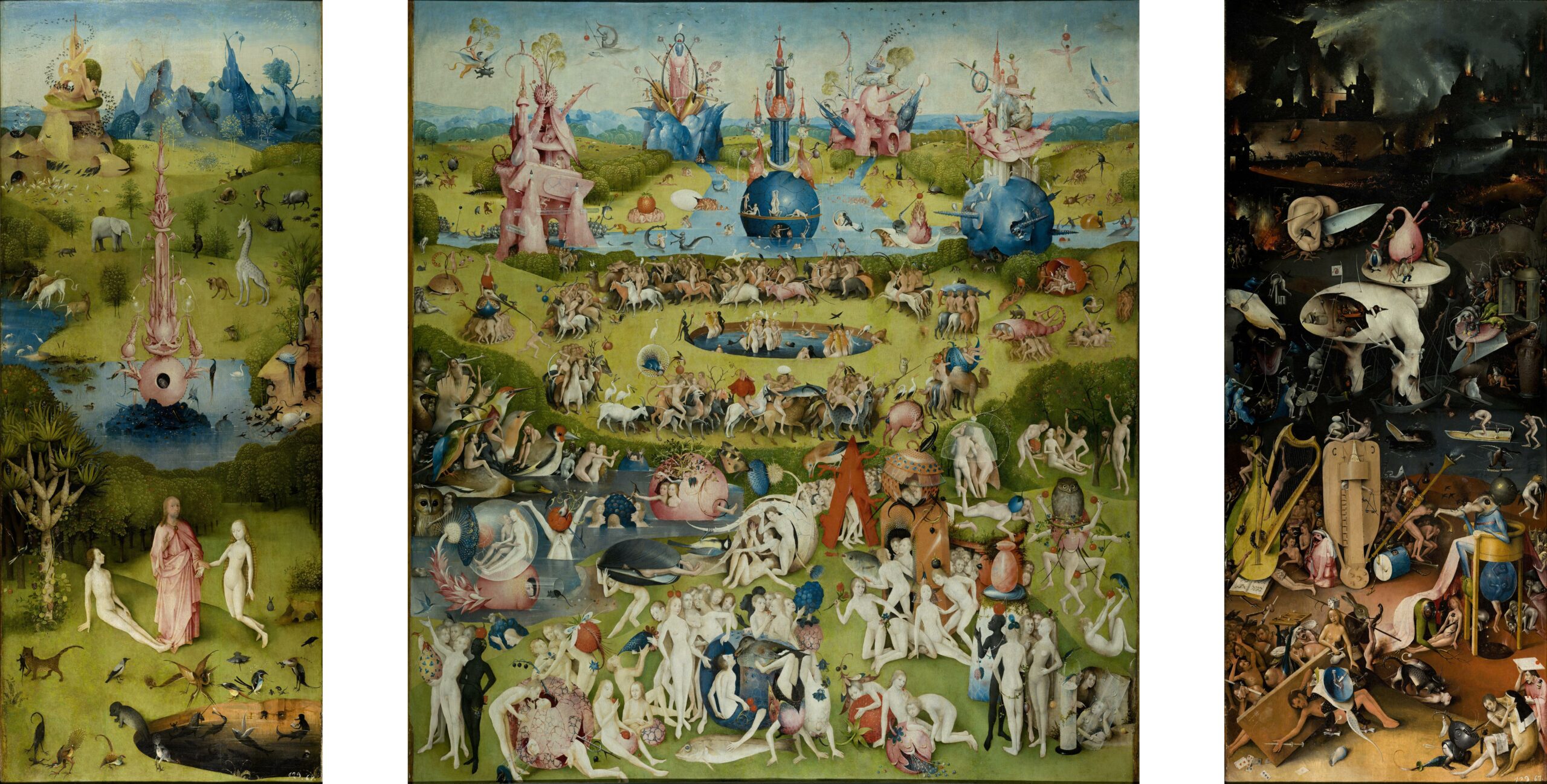
Jerome Bosch, Garden of Earthly Delightsapproximately. 1480–1490. Photo by Anonymous, Royal Institute for Cultural Heritage Photo Library. Public domain.
Garden of Earthly Delights taught me the consequences of looking at something for too long. In the auditorium where we held our art history class, it was pitch black, except for my professor’s pointing lamp and the bright light of the work on the giant smart board. We started by looking at the middle panel, then the left panel, then the right panel, and, finally, the outside—it was confusing. An almost sci-fi design on what appears to be a wooden cupboard, containing three wide-spanning panels. I still wonder, why do we start in the middle?
This work, a triptych by Hieronymus Bosch (1500–1505), is in the Museo del Prado in Madrid. The left panel depicts heaven (Eve, the source of life), while the right panel depicts hell. The central panel shows joy and enjoyment of life: there is a crystal ball on the left, which may allude to the Flemish proverb, “Happiness is like glass; it soon breaks.”
The left panel, compared to the rest of the triptych, is minimalist. God introduced Eve to Adam; they are naked and shy. All around there are green fields, lakes, animals. There is a fantastic pink structure in the center, and the sky is clear.
The middle frame shows the same landscape but has exponentially more life. It exploded. Everyone is naked and doing all sorts of activities, in pink bubbles, upside down in the pool with berries between their legs, twirling amidst seashells and fish heads. The eye moves upward, drawn to inexplicable floating fruit, lazing mermaids, and a fantastical, joyful pink tower—tacks that suggest a utopian society. Cherries, raspberries, and blackberries all dropped like tops on people’s heads. Bodies everywhere—upside down, dancing, intimate, creating friction. It’s like the feeling one gets when watching dogs wrestling: are they playing or fighting?
The eye moves to the rightmost panel, where it appears as if there is no sun or sky. It was a terrible sight—impressive but deeply unpleasant: burning cities, hideous bodies and body parts, strange demons, knives, fire. Animals punish and eat humans. There was a tree man—a man made of trees—with a bagpipe phallus on his head, looking very sad.
We should read the triptych from left to right: Adam and Eve → playground of sexy fruits with happy behavior → decay and hell. Most scholars have concluded that this is a linear interpretation of sin and the consequences of giving in to temptation. But the middle panel, where the teasing takes place, is very exciting and funny. At center right, for example, the buttocks of three people—gleaming with a silver sheen—glisten as openings that one can only imagine are the bodies of crustaceans. Above, a man rides a boat like a bronco while a cute-looking raccoon or baby bear sits, its tail up, thinking. Below, their friends carried everything as if it were a carriage. I love this: the berries, the body, everything is bright and pink and almost popping. When I learned that this cute scene was meant to lead straight to hell, I wondered why Bosch decided to make these little guys so cute. Why does he spend so much time and space describing pleasure, if it is meant as a warning? Something makes me feel like we got it all wrong—while the ending is inevitable, the middle panels are probably where we should linger. What if the mystery of the game is that it doesn’t result in destruction?
The Traitors
One form of play that certainly causes destruction is performance The Traitorswhich you can find streaming—atrociously, transcendently—on Peacock.
There is a lot of joy to be had from watching this show. It is a reality program originally inspired by a Dutch TV series The Traitorswhich comes to America in 2023. Hosted by Alan Cumming, That Traitor is a social deduction show, or one of the giant mafia games broadcast on television. The Traitors (two or three are selected and summoned with a tap on the shoulder from Cumming) are responsible for committing “murder” against the Faithful (a great word for a regular player) every night. If and when they kill all the Faithful, they win the game and all the money in the prize pot. If the Faithful defeat the Traitors, they win. Sometimes a loyal person can turn into a traitor, but betrayal carries great risks. At first I didn’t understand why anyone would want to be a Traitor, and then I realized: you get the most screen time by far.
The contestants are reality television stars, often from the Bravoverse. There are Housewives and there are Gamers (people from shows like that Happy, Older brotheretc). There are famous athletes and Love Island–ers and Drag Racing alumni. The fourth season (currently streaming) even features Donna Kelce—Travis Kelce’s mom—though Real Housewife Dorinda says she’s afraid to go after him “because of the Swifties.”
They all live in Alan Cumming’s castle in the Scottish Highlands, where he lives with his dog, Lala. They wore tartan outfits and small hats, doing their best to change their appearance in a communal and campy atmosphere. They ate together by the campfire, placing plates of food on their knees while whispering about murder. They pretended to poison a fellow player’s goblet of Pinot Noir, then took a small glass of ginger ale from the fridge and drank it in one gulp. They compete in challenges that involve their physical and psychological strength: they have to traverse a crazy fun house where clowns jump out when they go through the wrong door. Players are subjected to other trials: termites thrown over their heads, buried alive, or even held aloft in cages or on top of trees (where one can see across the meadow).
Sometimes it does look scary. There are masked guards holding axes. From campy to scary, there’s no breaking character.
In the end, they sat at the Round Table and accused each other of being Traitors. We will find out if they have colluded properly when the deposed star enters the Circle of Truth. Are they really who they say they are?
But all is not as it seems, in a more mundane way, which I prefer. I recently found out that this isn’t actually Cumming castle (not that surprising) but they don’t even stay there at night. Instead, they were driven back and forth to a hotel near Inverness Airport, most likely the Courtyard by Marriott. At night, Ardross Castle, a sprawling nineteenth-century estate on the River Alness, remains empty and waiting.
As Alan Cumming himself said: “What is good television and what is good gaming? Often, both occur simultaneously.”
When I was fourteen, I visited an area quite close by—it was vast, quiet, vibrant, and ancient. We stayed in a Victorian B&B two blocks from the river. I would walk to the water in the morning and crane my neck to peer south—where the river became the Loch, the great monster that lay beneath it.
My mandolin
When I first started working in the kitchen and my chef asked if I had a mandolin, I knew they weren’t talking about musical instruments, which meant I had no idea what they were talking about. Actually I don’t know what it is. I have decided to become a chef because of the challenge for myself.
The first time I had slicing on my prep list, my sous-chef showed me a mandolin—it was rectangular, made of plastic, with vertical protrusions and a perpendicular blade. He showed me how to transfer entire ingredients into a mandoline, palm flat, to turn them into a product that sliced with incredible speed and consistency. He told me, while agreeing with his fellow chefs, that people would lose their minds over this. This sentiment sounds familiar: I was also told about severed hands when they introduced me to meat slicers. So, like the meat slicer, the mandolin feels like something I have no business with. But the colors are cute: soft brown or mint green. I found out about a secret knife shop in Midtown, and when I went, I knew I’d take home a mint green one. Crisp!
I ended up really liking my mint green mandoline, and found it to be one of the most enjoyable tasks on my prep list. Sliding almost anything through the blade produces a clear sound, and it’s incredible how the pressure and sharpness create geometric consistency. I slice cucumber, celery, and fennel, activating the fresh, bright aroma as I go. Sometimes, it feels like slicing a rock.
During the lunch service, I was in the garde manger. Brunch is delicious, busy, and arbitrary—the best part is biking to the restaurant at 5:30 MORNING in the cold weather, watching the sun reflect from the corner window I passed, beckoned for the day. Service started at eight thirty, and I sliced apples, celery, and radishes for the salad set. Suddenly, a sigh and a feeling of wetness: the ring finger of my right hand got caught in the blade. Remember Bosch’s paintings? What did the Flemish say? “Happiness is like glass; it will soon break.”
I was sick of blood, so I looked away but felt a strange catharsis from the bodily chaos. Red on my cutting board, running down the kitchen drain, on my porter shirt. My sous-chef took me downstairs to the office, which is also the wine room. It was winter and the room was filled with citrus plants—grapefruit, pomelo, cara caras—because it was the most temperate room. Bright bottles and fragrances everywhere; it was somehow beautiful. I held my hands above my head and was given orange juice and five Advil (societal average). I asked if this was what people went to the hospital for. Maybe—but we need bodies to finish lunch.
My sous-chef was sweet, grimacing, and gently wrapped around my finger. I went up and—fingernails gone—finished the serve.
The next morning, I posted two slides on Instagram: the first, a diced beef tartare that I helped cut. Then a photo of my finger—sliced, diced. Obsessed with my courage, sensitive to something. I was twenty-three years old—what else was I supposed to do?
When I use the mandolin now, I do it carefully and slowly, with a different rhythm, with my palms flat. When I remember taking that photo and posting it, I cringed—not just from the pain of the cut but also from what I see now as an obsession with the mess I had gotten myself into. I archived it a long time ago, and I’m trying to forgive myself. If the numbers are still intact, I remember what Man Ray said about his Rayograph: “I will photograph an idea, not an object, a dream, not an idea.”
Rosa Shipley is a cook and writer living in Brooklyn. He wrote Substack Ceiling Cleaning.
News
Berita Teknologi
Berita Olahraga
Sports news
sports
Motivation
football prediction
technology
Berita Technologi
Berita Terkini
Tempat Wisata
News Flash
Football
Gaming
Game News
Gamers
Jasa Artikel
Jasa Backlink
Agen234
Agen234
Agen234
Resep
Download Film
Gaming center adalah sebuah tempat atau fasilitas yang menyediakan berbagai perangkat dan layanan untuk bermain video game, baik di PC, konsol, maupun mesin arcade. Gaming center ini bisa dikunjungi oleh siapa saja yang ingin bermain game secara individu atau bersama teman-teman. Beberapa gaming center juga sering digunakan sebagai lokasi turnamen game atau esports.