
“Slim-thick” mannequins. Photograph courtesy of the author.
1. Adam Phillips, On Flirtation (1994)
My mother is a strong proponent of batting your eyelashes in sticky situations; her mother preferred a strong drink and a withering gaze. Like hers, mine harbors vices and makes convenient excuses for abruptly leaving rooms. Evidence of sudden flight and ruthless pleasure-seeking accrues; she leaves a trail of chewed Nicorette all over her house and hides the metallic sleeves in the side pockets of car doors. She flirted her way out of quitting smoking during pregnancy in a Manhattan OB-GYN’s office in 1994, the year Adam Phillips published a collection of essays called On Flirtation that would change my life, or at least the way I tell my life story.
Flirting, it turns out, is not the acquired skill that the teen magazines wanted me to think it is, but rather an orientation toward desire, rigor, and deferral; it requires both the conviction to remain unconvinced and a skepticism about narrative cohesion. I first read On Flirtation in a fit of severe insomnia, on a stunning and astoundingly uncomfortable couch in my flirtiest friend’s apartment. He flirts with the truth—though, to be fair, he currently claims to be in recovery from pathological fabulism—but is also known to flirt with chaos, credit card debt, and discipline. To Phillips, a flirt is a charming rebel, drolly doubting our culture’s cherished, constricting notion of the “good life” as a linear project of becoming one’s “true” self, which usually means a spouse, parent, and worker.
On Flirtation describes a paradigmatic flirt in love with uncertainty, pleasantly mired in the enjoyable agony of curiosity. She isn’t ashamed to admit that she doesn’t know what she wants, and worse, that she knows that you very well might have it in your back pocket and could keep it there. She has no clue where she’s headed—you’re the one living like you’re trapped in a noir, anxiously eyeing the exit–but has a skip in her step anyway. The worst part is that she’s in such a good mood. Sorrow is no stranger to her, as my mother would say, but she wears it well, with convivial commitment to the bit. She knows she has great aim, she just has a thing for moving targets.
Phillips observes that flirts “are dangerous because they have a different way of believing in the Real Thing. And by ‘believing in,’ I mean ‘behaving as if’ it exists.” In an early chapter, titled “Contingency for Beginners,” he writes that the flirt’s future “is not only the home of wishes but also the resort of accidents,” a not-so-sleepy vacation town populated by people who take chances as often as they give them, relying on ellipses instead of periods. The flirt spies a fork in the road and sits down until she spots a car worth sticking her thumb out for. There’s a cerulean Volkswagen in my neighborhood with a vanity plate that reads LIMINAL.
2. Skims flagship, Fifth Avenue (opened 2024)
Mere blocks from Rockefeller Center’s shrine to shopping and Saint Patrick’s Cathedral, the Skims flagship store is well located to hawk the vestments of body fascism. Skims, founded by Kim Kardashian in 2019, is a “solutionwear” company selling Spanx-adjacent compressive clothing and undergarments. I recently visited Skims with a violently heartbroken friend, freshly excised from the life she’d thought was hers.
Now she was flirting with wrath, catharsis, sleeping pills, friends’ brothers, and grace. Ejection brought with it accidental, angular relief. New roles require costumes, and Skims sells constriction in the name of liberation, so really, where else could we go? The mannequins were all “slim-thick,” so we knew the material would stretch across multiple possible futures.
In the lobby, a headless-girl David stood three stories tall, her delicate smattering of sculpted pubes facing the second-floor windows. Girls scurried around while women trod lightly, looking over their shoulders, afraid of running into an acquaintance while buying indulgences, in both the Catholic and capitalist senses. They scrambled up the stairs, swarmed the “Seamless Sculpt” table, and stood, fidgeting, in line for Communion (free gift at checkout).
In the dressing room, hiked spandex and hitched breath: a microexorcism in front of the curvilinear mirror. Each floor’s high ceilings belied the shallow back stock. We couldn’t find our size in anything we were looking for. Up another spiral staircase, on a quest that was starting to feel more Sisyphean than stylish. On the third floor, I was heartened to see two brunettes dissolving into hilarity around a panties table, slingshotting thongs across the pawed-over display. Another woman appeared to be pasting her friend back together by the bathrobes, heaping silk over her heaving shoulders.
When we left, after spending unspeakable and therefore redacted sums on garments, most of which easily fit in the palm of my hand, one of the handles of my friend’s Skims bag immediately broke. I tried to tie it to the remaining ribboned handle, and suddenly we were the ones dissolving into hilarity. “People organize their lives to avoid the imagined catastrophe of certain conversations,” Phillips writes. My friend had survived a dialogue that derailed her life story as she knew it, but flirts aren’t daunted by a jump onto or off a moving train and know that “personal history is an elusive god.” Such skepticism is easily mistaken for superstition, but in fact, it can “protect[s] us from idolatry.”
A suspect is herself a poetic figure, flirting with the slow reveal, and usually a decent excuse for a sex object. Girl David might have a perfect body, but a real femme fatale takes the files with her. In tears, I once misheard a friend and thought he had coined the term informationship. Another friend is an archivist, an avid FOIA-er who’s developed a sort of Stockholm syndrome with respect to redactions, which has, in other friends’ opinions, infected her love life. But missing plot points and censored storylines encourage reading between the lines, scrawling marginalia that might end up in someone else’s mouth. We realized that we didn’t want to worship at the altar of girl David’s immobility, that solutionwear implied that our bodies were problems to be solved instead of vessels for our laughter, so we went to get dim sum.
3. Fabulous app (founded 2013)
This all started around a year ago, when a cartoon skull with a bow in its nonhair repeatedly accused me of being dead inside. He/she/they appeared in my feed as I swiped through Instagram stories, insisting that my heart rate was irrelevant to my rizz ratio and that my dopamine quotient was in my control: I could learn how to be “THAT girl” if I downloaded an app called Fabulous. Admittedly, I didn’t know whether I’d beat the dead-inside allegations at a tribunal of my loved ones, though I wondered defensively if someone dead inside could drive an escape vehicle from a psych ward in a T-shirt that said ANGEL or convince a roadside mechanic to discount a tire while his wife glared laconically from a lawn chair, both of which I’d managed recently.
As fabulous is a word I will admit to overusing, I was vaguely intrigued by the potentially fated impact this app could have on my inner life. My phone was haunted by the girly skull even as I swiped frantically past its sponsored stories. It smiled and implored me to disappear for six weeks and come back completely rebranded, and when I didn’t take the bait, it began exhorting me to disappear for eight weeks and come back as the woman I needed as a girl.
When I finally broke and decided to find out what @thefabstory was actually selling—retreats, spa-like inpatient programs, girlboss training camps?—I learned that Fabulous is a subscription-based cognitive behavioral therapy app that promises to help users build healthy habits and in turn achieve their life goals. Redditors argue it is an impossible-to-cancel service preying on the neurodivergent that “love-bombs you with crap.”
I downloaded the free version, which kept glitching when I tried to click into any of the home screen’s offerings, so I cannot report on the efficacy of meditations ostensibly inspiring “Blistering Focus” (demanding an astonishing 122 minutes) or “Meaningful and Deep Work” (a slightly more promising 48). When I navigated to the app’s About section, I learned that it was developed in the Department of Economics at Duke University—specifically, a subsidiary institute called the Center for Advanced Hindsight, which, according to yet another about page, “was created out of [its founders’] love affair with the hindsight bias, a phenomenon where people find things to be more predictable after they have occurred.”
The app operates from the premise that if its users employ its CBT exercises to accomplish tasks, they will fall prey to, or ideally—like Duke’s behavioral economists—in love with the hindsight bias. Their achievements, once unimaginable, become predictable, and subscribers will pay to stay in this storyline, becoming the people they pretend to have predicted all along. This fetish for retrospect evinces a refusal to acknowledge that we all end up, in Phillips’s view, “living too few of our lives,” a reality that flirts find romantic, if daunting. Fabulous’s CBT tactics not only make the story you’re already in livable but also insist on its inevitability, rendering the user-protagonist a hero simply for surviving and a genius for seeing it all so clearly. I’d rather wear sunglasses at night or try on your prescription.
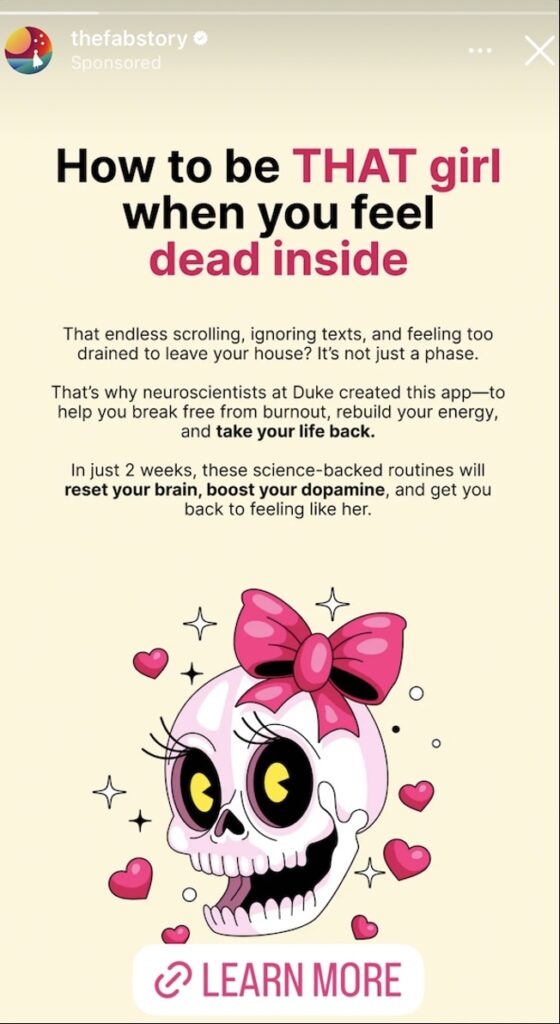
A Fabulous-sponsored Instagram story.
Phillips contends that “coincidences belong to those who can use them,” so I interpreted the app’s refusal to let me use it as one such useful coincidence: I had no choice but to make my own choices. Rather than rely on its calculations and storybook structures, I had to flirt with fate and my own impulses. Flirts aren’t afraid to refute the piety that “a secure self-image is something we all want—or more absurdly, could even have,” as Phillips puts it, because we know we’re made by the people we’d try on any lenses to see. It’s “only when two people forget themselves, in each other’s presence, that they can recognize each other.” Flirts know that a person who catches your drift will likely end up knocking the wind out of you. You’ll be someone new when you manage to get up.
Flirt with the story you’re telling yourself and you might find an alley previously unphotographed for Google Street View—like the one my friend lives on at Beach Eighty-Seventh Street in the Rockaways, with a dog she found on a sandbar in another country—or a potholed road on which to drive recklessly, because who knows who you might meet hitchhiking after the tire blows? I saw a Hasid hitchhiking the other day, but the only person who would have imagined it right does not speak to me anymore, so I didn’t tell anyone about the man’s calloused thumb in the gloaming.
Once the skull realized it couldn’t get me to cough up $49.99 a month, it shape-shifted into a lavender fairy who spoke to me more softly, in cursive, insisting that “you don’t have to kill your darlings to get things done.” This new AI-generated glistening golem wanted to “glow up [my] mindset.” I reframed an old abandonment: someone who only told me their secrets in the ocean was always going to take a tidal approach to knowing me. The skull and the fairy followed me for a while, but eventually those animated faux messiahs realized they had nothing to offer a girl more interested in insight than hindsight or foresight. A woman I met on a Brutalist balcony once insisted that a doctor X-ray her arm after a night out, because she thought someone’s exhale had gotten stuck in her shoulder. I didn’t believe her, but I nodded earnestly, and then I took that show on the road, not without additional color.
I’m neither the girl I once thought I should be nor “THAT girl” Fabulous thought I could be, the smug one who saw it all coming in the rearview mirror. I like my car’s side mirrors, where objects are closer than they appear. Flirting, Phillips writes, is the “art of making ambivalence into a game,” of playing a bad hand with panache or playing for time because the countdown clock’s buzz gets grating. If the app hadn’t been so glitchy, perhaps it would have gamified my life according to rote rules toward reliable, foregone outcomes. But let yourself off the hook and see what snags on the metal. Pocket the cards, Irish exit, make a raucous run for it—escape artists aren’t as lonely as you think. Houdini was in love with at least one of his accomplices. Suspense can be a form of invitation rather than a kind of caution tape, which is never as sticky as it sounds. I asked someone to teach me a game recently, and then I listened closely and lost badly. Also: I had a great time.
News
Berita Teknologi
Berita Olahraga
Sports news
sports
Motivation
football prediction
technology
Berita Technologi
Berita Terkini
Tempat Wisata
News Flash
Football
Gaming
Game News
Gamers
Jasa Artikel
Jasa Backlink
Agen234
Agen234
Agen234
Resep
Download Film
Gaming center adalah sebuah tempat atau fasilitas yang menyediakan berbagai perangkat dan layanan untuk bermain video game, baik di PC, konsol, maupun mesin arcade. Gaming center ini bisa dikunjungi oleh siapa saja yang ingin bermain game secara individu atau bersama teman-teman. Beberapa gaming center juga sering digunakan sebagai lokasi turnamen game atau esports.
