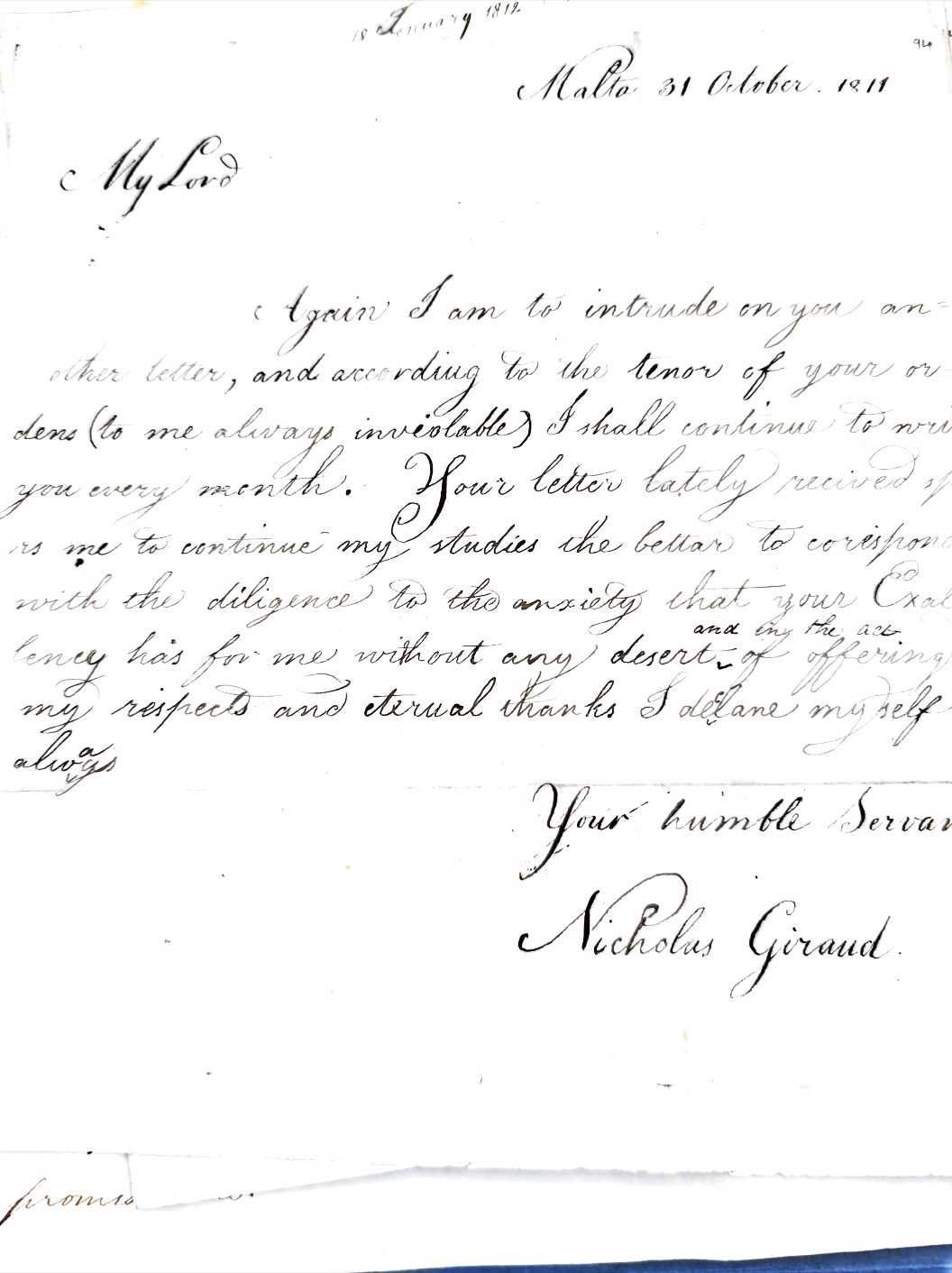
LETTER 5: October 31, 1811, Nicolas Giraud to Byron. All letters courtesy of The National Library of Scotland.
Lord Byron’s bisexuality is well known—but Byron’s archive still has the power to surprise us with new evidence about this part of his private life. Here are the first full English translations of eight letters written to Byron by his boyfriend Nicolas Giraud, with whom Byron had a not-so-secret relationship in Athens in 1810 through 1811. Giraud’s letters have not been published in full before, partly because they are difficult to decipher—they are written in misspelled and ungrammatical Italian, English, and an antiquated Greek script—and partly because they trouble Byron’s legend as a great lover of women.
As a teenager and young adult, Byron had several “unequal friendships,” as his associates dismissively called them, with other male youths. Written in the messy aftermath of the only such “friendship” that was unquestionably a sexual relationship, Giraud’s letters disclose the serious, romantic valences of Byron’s same-sex intimacies. They also reveal Byron’s private struggles during his years of fame. While performing the role of the straight heartthrob in public, Byron was concealing his more complex history—no matter the sacrifice to his feelings.
Their relationship began after twenty-one-year-old Byron fled England for a Grand Tour of the Mediterranean, escaping crushing debts and a pregnant maidservant. In Athens, Byron befriended a painter who was helping Lord Elgin remove the Parthenon marbles—a theft that Byron deplored. Still, the painter introduced Byron to Nicolas Giraud, his fifteen-year-old relative.
In August 1810, Byron moved into the Athenian school where Giraud was a student. Under cover of taking Italian lessons—a language Byron did learn—and between “scamperings and eating fruit and peltings and playings,” the two became lovers.
It was with Giraud that Byron had his “first” experience of plenum et optabilem coitum, Byron’s code word for same-sex relations. Byron wrote that “above two hundred” encounters followed, until the couple drew attention to themselves when they consulted a doctor—as rumor had it, about an injury Giraud had sustained during sex. Soon after, Byron began covering his tracks by paying local women for sex, a practice that grew perilous when the foreign men at Athens “were all clapped” with gonorrhea.
Still, Byron continued to live at the school with Giraud until April 1811, when he left Athens for England. At first, he took Giraud with him. But Byron had second thoughts about bringing home a male companion, and he left Giraud in Malta. There, he paid for Giraud to attend school, telling him to learn English. It was a tender parting. Alone at sea, Byron was “sick at heart.” In England, he rewrote his will to bequeath seven thousand pounds to Giraud—a sum he did not then possess.
Expecting a swift reunion, Giraud wrote Byron ingenuous letters about his feelings for his lover and patron. The power dynamic of their relationship is evident in Giraud’s inflection of pederastic servility: he calls Byron “Your Excellency,” “my dear, precious Master,” and “my merciful father.” Giraud obeyed Byron’s order to learn English—although he invariably uses Greek for his most heartrending declarations.
But in the end, Giraud gave up on his lover’s return and left Malta sorrowfully. He had tried “to abstain” from same-sex relationships, as Byron had urged, but in 1812 he was expelled from school after escorting another Englishman to the theater. It is not clear when Byron ceased to write back. Giraud’s last letter, written from Athens on January 1, 1815, the day before Byron married Annabella Milbanke, vents his grief about being ghosted.
Through cruel, Byron’s silence seems less cavalier than calculated, the consequence of his turn of fortune. His poem, Childe Harold’s Pilgrimage, had made him a celebrity; he was officially “mad, bad, and dangerous to know,” in the words of his lover, Lady Caroline Lamb. As Byron began affairs with aristocratic married women, Giraud’s letters were becoming a liability.
Only once did Byron reflect obliquely on the same-sex romances of his youth. In his destroyed Memoirs, Byron had omitted the “really consequential and important” truths of his past, “out of deference to the dead, to the living, and to those who must be both.”
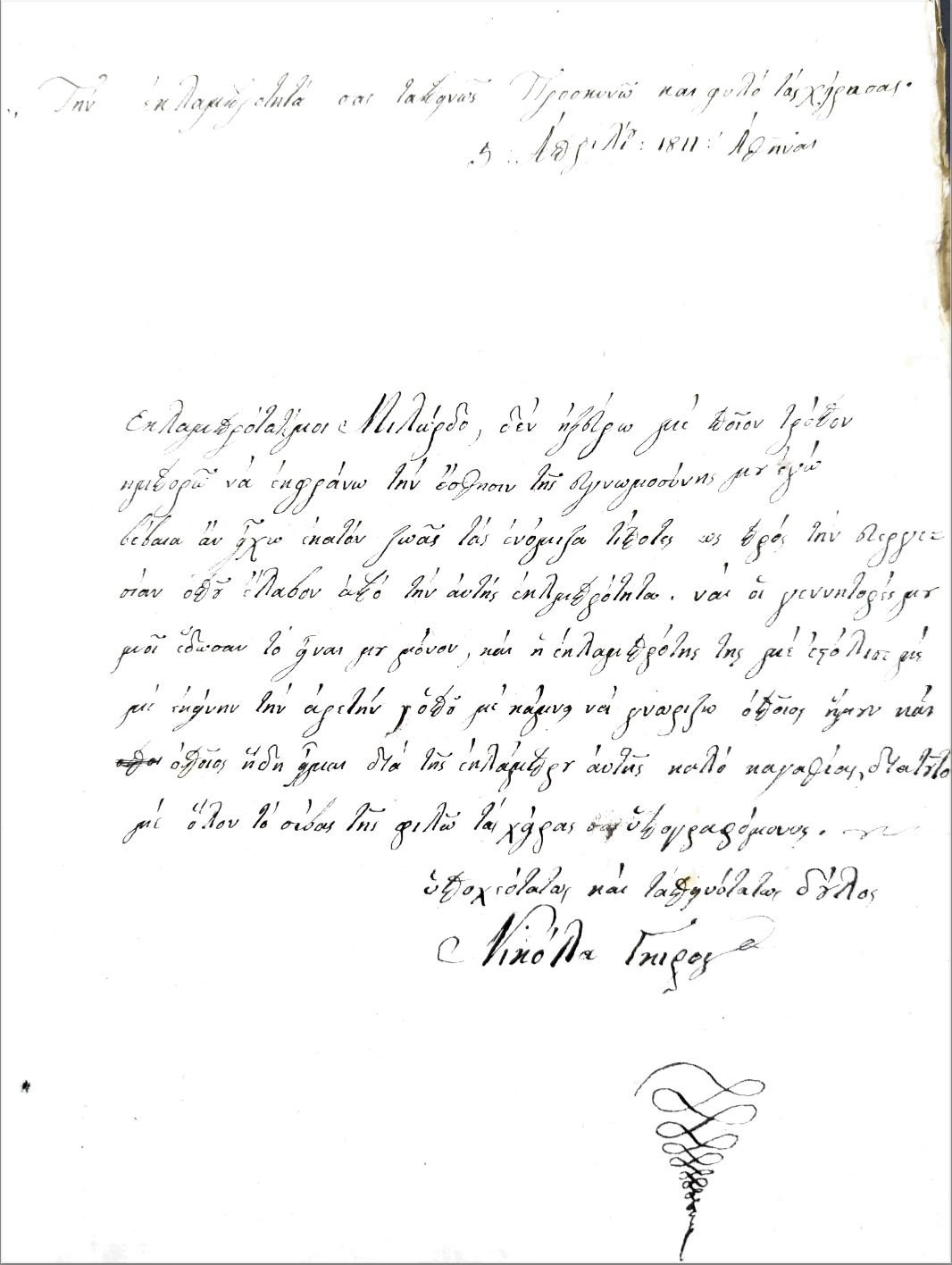
Letter 1, Nicolas Giraud to Byron.
Letter 1
April 5, 1811
Giraud to Byron
[Greek]
I humbly greet your Excellency and kiss your hands,
5 April 1811, Athens
My most excellent Lord, I do not know how I can express my sense of gratitude. Had I a hundred lives I would think them nothing compared to the affection that I have received from your Excellency. Indeed, my parents gave me but my existence, and your Excellency adorned me with that virtue which makes me know who I was and who I already am, through your own nobility, for which with all respect I kiss your hands,
Your most humble, most obliged servant,
Nicolas Giraud
[Enclosure]
My most excellent lord, Lord Byron
Britain
Letter 2
July 1, 1811
Giraud to Byron
[Italian]
Excellency,
It would have been very dear to me to be with you in Nottinghamshire for many reasons, but especially so as to turn your heart towards me. Now I wish that your excellency had that love towards me that I experienced being with you, but oh God! Since I am so far, oh how completely troubled and afflicted I feel. For this reason, I was comforted in thinking about your kindly presence. However, to not bore you with my terrible verses I give myself the honor of begging you to keep extending your protection to me which I have never doubted and finally I declare myself as I embrace you and exhibit myself as your son and you as my merciful father whom I will always venerate. And I will always venerate your commands. And with pleasure as I say this, eternally.
To not fall short of my duty, I send you all of my respects and regards. As for Mr Lusieri, he left here on the 25th of June and already I have news from him oh my Lord that he sent your Excellency my letter sent with Mr Egart. I hope to receive from your Excellency consolation as to your excellent heath and once again I declare myself always your most humble servant and that I am always happily studying as your Excellency desires and I hope to continue my studies with the help of God so that your ambitions in me will come true as you hope to see me advancing and able to fulfil my duties towards you. Once again I profess myself until death your humble servant.
Your Excellency, Malta, Valletta, 1 July 1811
Humble servant,
Nicola Giraud
Letter 3
July 10, 1811
Giraud to Byron
[Italian]
Your Nicola Giraud keenly desires never to be distant from your eyes. I happily endure this distant separation, because I persuade myself that every action that I endeavor to undertake will further your attentive benevolence towards me and I hope fully to fulfil my duty in my ongoing studies. You find me very anxious as to the state of your health and I burn to tell you of my good health, with every internal effort to abstain.
I beg your excellency to regale me with your news. I have improved, with this letter that I have given to Mr Dancy, that he might bring it to England, or send it to your excellency with Mr Egart and another with Mr Gream on June 30th [.] Mr Gream told me that he will go to Spain before coming to England. I thought that it will take him a long time to get there so I felt the urgency to respond. And so here I am, declaring myself ready [indecipherable]. So as not to bore you further I claim the honor of embracing you and of exhibiting myself by begging you for your protection, while I declare myself your Excellency’s
Malta Valletta 10 July 1811
Most humble and obliged servant,
Nicola Giraud
[Postscript in Greek]
I hope that Athens desires us again together one more time. I greet my master
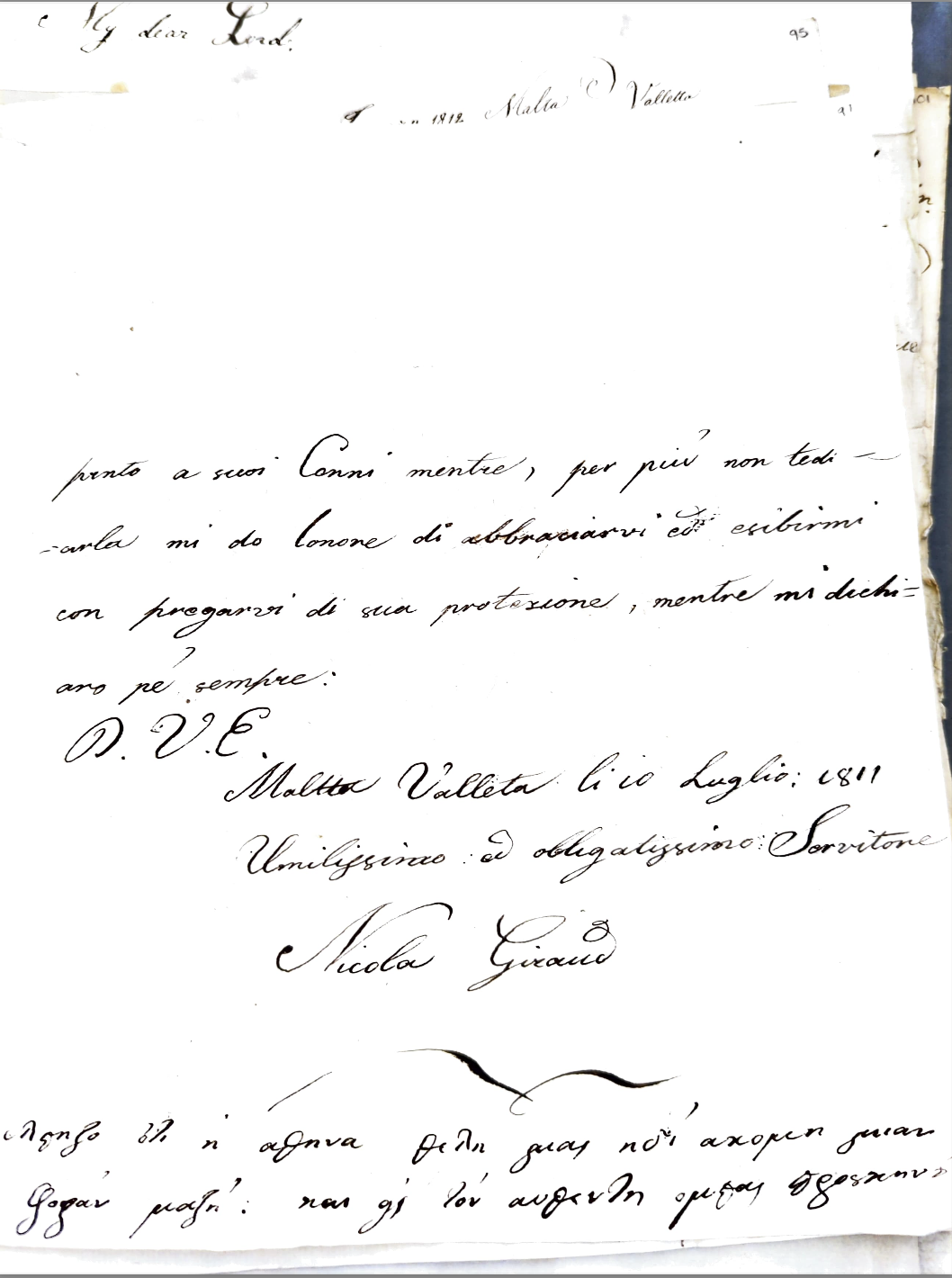
Postscript to Letter 3.
Letter 4
July 10, 1811
Giraud to Byron’s servant Demetrius Zografo, who had accompanied Byron to England
[Greek]
My master, Mr Demetrius, I send many greetings and kiss your eyes and ask God for your good health. Let me say that I have not yet received any letter from Athens and I do not know how they are, but as soon as I receive one I will send it to you at the first opportunity. Nor have we received anything from you, master, and we do not know how your journey was. I ask you to beseech my Lord to write often, and if my Lord does so that you, master, do so too, and write to me often. And if you ask after my health, very well. Send many greetings to Spyros. No more, and may God grant us happy meetings,
Malta Valetta July 10, 1811
Your most humble servant
Nicolas Giraud
[Enclosure]
Signor Demetrius Zografo
[Byron’s Greek servant]
Letter 5
October 31, 1811
Giraud to Byron
[English]
Malta, 31 October 1811
My Lord,
Again, I am to intrude on you another letter, and according to the tenor of your orders (to me always inviolable) I shall continue to write you every month. Your letter lately received spurs me to continue my studies the bettar [sic] to correspond with the diligence to the anxiety that your Excellency has for me without any desert and in the act of offering my respect and eternal thanks I declare myself always
Your humble servant
Nicolas Giraud
Letter 6
January 18, 1812
Giraud to Byron
[English]
18 January 1812 Malta Valletta
My dear Lord
I have received your dear letter by the hands of the two Albanese of the Marquis of Sligo, written by your Writer Demetrius on the 6 of December 1811, so ordered by your Excellency in which he writes me that your Excellency had received two letters of mine and two from my Italian Master and that if my letters were written in English they would give you greater pleasure, but I remember very well that when you were in Malta, you told me not to write it until I could do it without mistakes, and for that reason, I did not write you in that Language then: but now that I can do it, I write you in English, and have also written you two other letters before this. He informs me, that your Excellency will come back to Malta in June, which gives me very great pleasure, and I shall begin now to pay more attention to my studies that when you come you will find me as you wish.
I Remain your Obliged and humble Servant
Nicolas Giraud.
[Postscript in Greek]
My precious Master, when I came to read in your letter of your desire to return here, I almost went mad from joy. I beseech God day and night to grant me the favour to see you again.
O All-powerful Lord,
Grant me this joy,
To see my Lord,
My dear, precious Master.
Nicolas Giraud.
I received a letter from my mother, and from Sig. Lusieri, who send you many greetings. They are in good health, as am I.
[Enclosure]
Lord Byron
[In Byron’s hand]
Nicholo Giraud Malta
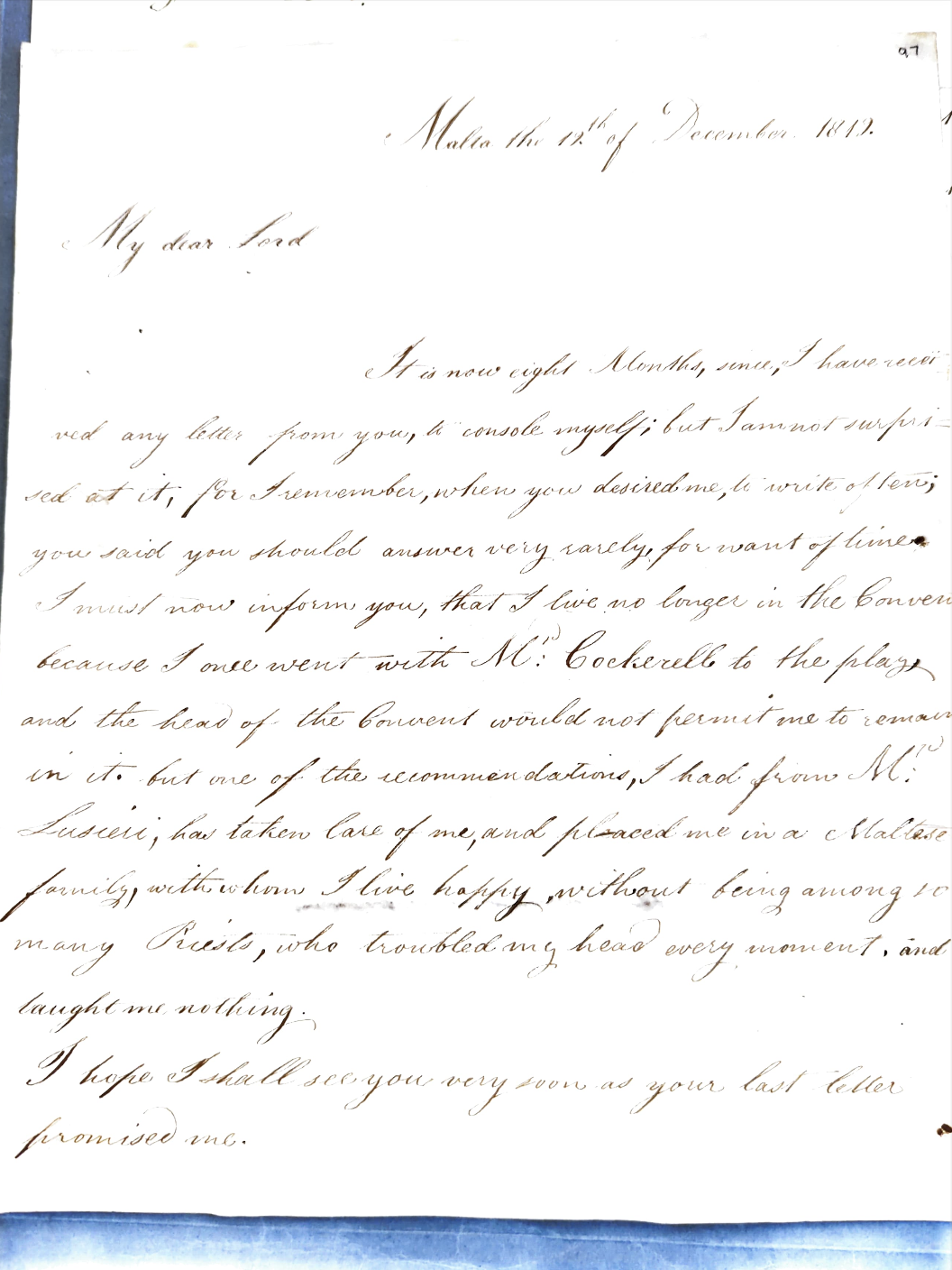
Letter 7.
Letter 7
December 12, 1812
Giraud to Byron
[English]
Malta the 12th of December 1812
My dear Lord
It is now eight Months, since I have received any letter from you, to console myself; but I am not surprised at it, for I remember, when you desired me, to write often, you said you should answer very rarely, for want of time. I must now inform you, that I live no longer in the Convent because I once went with Mr Cockerell to the play, and the head of the Convent would not permit me to remain in it, but one of the recommendations, I had from Mr Lusieri, has taken care of me, and placed me in a Maltese family, with whom I live happy, without being among so many Priests, who troubled my head every moment, and taught me nothing.
I hope I shall see you very soon as your last letter promised me. Mr. Luisieri and all the Family, respects to you.
I Remain your most humble Servant,
Nicolas Giraud
[Postscript in Greek]
sends you greetings and desires to see you
[Enclosure]
To The Right Hon. Lord Byron
Newstead Abbey
Nottinghamshire
England
Letter 8
January 1, 1815 [written the day before Byron’s marriage]
Giraud to Byron
[English]
1 January 1815, Athens
My dear Lord
It is now almost two years that I am at Athens, and I have sent to you many letters, but I have not received any answer of you. Shall I suppose that none of those letters are arrived to you. I pray your excellence to not forget your humble servant which so dearly and faithfully loves you. I continually pray the God to give you long life, and to give me the grace to see you another time, which shall be to me an inestimable pleasure alike that of Telemachus, when founded his Father.
I remain your most humble Servant Nicolas Giraud
[Postscript in Greek]
Oh my precious Lord, I cannot describe the sorrow that my heart feels at not seeing you for so long. Oh that I were a bird and could fly over to see you, just for an hour. I would be happy to die on the spot. Hope tells me that I will see you again, and this is my consolation for not dying. It is now two years that I am in Athens and I have entirely forgotten English, having not spoken it:
My mother, sisters and Mr Lusieri
send you many greetings
[Enclosure]
Right Hon:ble
Lord Byron
Newstead Abbey
Nottinghamshire
England
Arden Hegele is the author of Romantic Autopsy. She is writing a biography of Byron.
Translations by Chloe Howe Haralambous (Italian) and Joshua Barley (Greek); Greek transcription by Maria Theotokatou. Letters courtesy of the National Library of Scotland.
News
Berita Teknologi
Berita Olahraga
Sports news
sports
Motivation
football prediction
technology
Berita Technologi
Berita Terkini
Tempat Wisata
News Flash
Football
Gaming
Game News
Gamers
Jasa Artikel
Jasa Backlink
Agen234
Agen234
Agen234
Resep
Download Film
Gaming center adalah sebuah tempat atau fasilitas yang menyediakan berbagai perangkat dan layanan untuk bermain video game, baik di PC, konsol, maupun mesin arcade. Gaming center ini bisa dikunjungi oleh siapa saja yang ingin bermain game secara individu atau bersama teman-teman. Beberapa gaming center juga sering digunakan sebagai lokasi turnamen game atau esports.