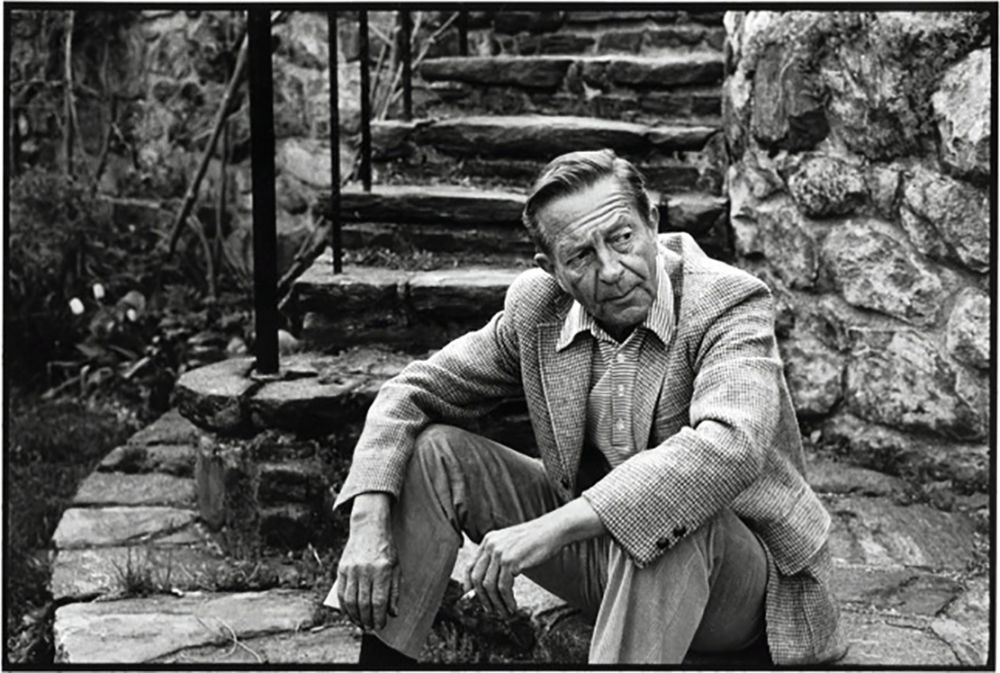
Photograph by Nancy Crampton.
Over a morning cappuccino in a small but lively European café that spilled onto the central square of a town near the sea, I first read “The Country Husband,” my introduction to John Cheever, on a website I later discovered was inaccessible in the U.S. The website, all in Arabic except for the stories, was an arsenal of midcentury American fiction, a canon I had resisted knowing anything about.
I was, at the time, in a phase of my development as a poet that I would call fiction-averse. I thought poetry was what you discovered, like a rare ore, when you unbuckled the artifice that contained language in narrative. Naturally, then, I tried to write poems that rejected anything that might pass for fiction: smooth, grammatical sentences, captivating or manipulative plotlines, and, most egregious, the implicit desire to wrangle language into utter invisibility while the reader watches a movie in her head.
“The Country Husband” was, at least by reputation, so exactly what I’d been avoiding that I’m not quite sure why I chose to punish myself by reading it. The story concerns a man, Francis Weed, who lives in Cheever’s invented Westchester town, Shady Hill, with his wife and children. Weed falls in love with the babysitter, the most cliché thing a married suburban father can do. She doesn’t love him back, and he doesn’t change his life for her, and that’s the story. He must learn to live past this rupture in his heart.
When I read the story, I was convalescing from an affair with a married person. I did love him back, and he didn’t change his life for me, and since you can’t heal at home from a heartbreak nobody knows about, I had gone abroad. Nothing in my life seemed to be working, and I must have searched up Cheever as part of my attempt to try the opposite of everything I had been doing. I had to admit that in the mirror “The Country Husband” held up to me, I appeared a little less broken than I felt. Writing from Francis Weed’s point of view, Cheever had, at a time when I really needed it, validated my experience of how powerful and real and obliterating extramarital love can be—even and especially for the married party. This, by the way, was years before the ubiquity of open marriages made moot the need for affairs, the way de Tocqueville has described the democratic election’s quelling the need for violent revolution. But the impulse to escape, resist, defy; the flirting with destruction, complete overhaul, change—this doesn’t go away just because one container for it has gone licit.
Cheever lived with his wife and children in the real Westchester, during a time when, as Susan Cheever’s new memoir reminds us, you could pay for your daughter’s braces by publishing a short story. (She cites the cost of her orthodontia as the impetus for her father to write “The Country Husband.”) His journals are full of that impulse, the desire for more, the demand for better, of which affairs, at their best, are only one manifestation. Cheever drinks, wrestles with his drinking, and drinks again. He cheats on his wife, often with men, wrestles with his sexuality, and cheats again. He loves sex and literature and writing and family and is devastated by them. He keeps banging his head on the ceiling, his shoulders on the walls, and his knees on the floor of his own life, trying to expand himself to fill it. In one section of the journals, he wakes in the middle of the night in a state of profound physical discomfort: “I am soaked with sweat and shiver convulsively at any touch of the night air.” From this position, he has a vision:
I see my family—Susie, Rob, Ben, Linda, Mary, and Federico—and how much I love them, how perfect is my contentment! This seems to be not love but a perfect equation in which light is exchanged. And, half asleep, I think I see some way of getting back into my work. It is the old image of spatial arrangements—not tables and chairs but abstract form. The light is sombre but not dim, not soft, a strong, pure gray light. By moving the forms, by changing the spaces between them, something seems to be accomplished. A voice from somewhere says, This is neither erotic nor spiritual. I see a rock pool in Maine, filled at high tide. I wonder if there is any erotic cause for my excitement. I think not. The pool seems beautiful and serene.
How beautiful and serene and painful and psychedelic life was for Cheever, like a Renoir retrospective in which, from certain angles, all the girls might be boys. Life as rock pool, no matter the tide. Submitting yourself to the fundamental earthliness of life, “struck,” as Cheever writes in “The Country Husband,” “by the miraculous physicalness of everything,” you gain access to a higher, purer experience even than what we call love: “a perfect equation in which light is exchanged.” And “getting back into my work” is related to it, as if you had to be in love to write well, when I had always thought it was the opposite.
What I loved about “The Country Husband,” in addition to its perfect final sentence, was that it captured, in ways recognizable to me, how Francis Weed’s illicit love allows him to touch what, elsewhere, Cheever describes as “the harsh surface beauty of life.” “His spirits were feverish and high,” he writes of Weed. “The image of the girl seemed to put him in a relationship to the world that was mysterious and enthralling.” In the midst of such feelings, Weed runs into a tedious neighbor, “old Mrs. Wrightson,” on the train platform. She drones on about how she must repeatedly descend into the city to repair her curtains until Weed tells her to paint her windows black on the inside and shut up. She walks away “so damaged in spirit that she limped.” Weed feels wonderful, “as if light were being shaken about him.” His secret love has given him the courage and the energy to liberate himself from bullshit. This passage has come to my mind nearly daily since I read it:
Among his friends and neighbors, there were brilliant and gifted people—he saw that—but many of them, also, were bores and fools, and he had made the mistake of listening to them all with equal attention. He had confused a lack of discrimination with Christian love, and the confusion seemed general and destructive. He was grateful to the girl for this bracing sensation of independence.
What Cheever speaks of here is the freedom to access to your true capacity for discernment. It is the freedom to know what you really think, to determine for yourself the worth of prevailing social values. This sense of discovering my own deepest discernment is what led me into an affair in the first place, a kind of access that, when the affair failed to manifest a livable relationship, I feared I’d never have again.
Unlike his author, Francis Weed never really cheats. I would say that Cheever might have admired his character’s restraint, only Weed’s restraint is forced on him by the girl’s lack of interest. It’s as though Cheever wants to say: There are limits to what adultery can do for you, and trust me, I know what they are, but what kind of story would this be if the protagonist were so morally upstanding that he would choose not to find out what they are for himself? What is moving about Cheever is how he lived in the tension between whim and obligation, freedom and restraint, celebrating (and suffering from) both. Despite his personal foibles, he had no patience for people who lived by whim alone, and he was especially critical of those who seemed to think that because they were writers, they weren’t subject to the same rules of behavior as everyone else. In a passage of his journals where he lays into Jack Kerouac, he notes how his life and Kerouac’s meet at “almost no point,” since Cheever is “most deeply and continuously involved in the love of my wife and my children.” He sees Kerouac’s whole way of being as neglectful of the fact that there is “some wonderful seriousness to the business of living” from which “one is not exempted by being a poet. You have to take some precautions with your health. You have to manage your money intelligently and respect your emotional obligations. There is another world—I see this—there is chaos, and we are suspended above it by a thread. But the thread holds.”
Cheever repeats this language at the end of “The Country Husband” when the force of Weed’s established, pre-babysitter life has swallowed him back up: “The village hangs, morally and economically, from a thread; but it hangs by its thread in the evening light.” I suppose this is the only kind of optimism that makes sense to me: the hope or, better, the conviction, that the thread will hold.
I used to write poems from convictions. I lay them out now in cover letters. I talk about how poetry is a place that relieves me of my complicity in narrative’s conspiracy, as Robert Creeley’s poem “The Pattern” expresses so well: “As soon as / I speak, I / speaks.” What at first feels like a conjugation issue points us to a worldview that sees the self as divided into the part that tries to say something cohesive and a new part, birthed in language, that is entirely separate from the first part—so separate, in fact, that verbs hit by its force field are conjugated in the third person. To write, one must surrender one’s I to that other I, the “I speaks” one, who is subject to the rules of language, not the rules of biology, psychology, and physics.
If I no longer quite believe any of that, what I do still believe is that the activity of writing poetry is a calling, and that to heed it cultivates a kind of mystical access, a relationship to forces working through me to shape my life into its truest form. Sometimes it is easiest to recognize a calling when you are called to do something you wouldn’t normally do, like break a rule, whether of grammar or society. When I wrote poems that interrupted narrative continuity, when I used enjambment to suspend and call attention to the default grammatical flow of sentences, and when I gave someone else’s husband a key to my house, I saw myself as heeding my calls.
In that European café, where, after what felt like losing everything, I found John Cheever, I was hit over the head with a hard truth. My refusal to engage with narrative was the kind of blindly totalizing rejection that in some circles might even be called a limiting belief. I guess you could say that Cheever showed me what my life’s events were already trying to show me: just how unexempted I was from the business of living. He planted in my head a thought that would have been so threatening to the version of myself that existed before the affair that, back then, I wouldn’t have even been able to think it: What if I just care more when I’m reading about people? Forbidden companion thoughts also surfaced: Why am I not writing more about people? Why am I not writing about myself?
I had big theories to protect me and a big secret to avoid talking about, but I also had to wonder if I wasn’t writing more about myself simply because I felt the way most of us feel about ourselves, the way Cheever felt about the title character of his story “Brimmer,” which begins, “No one is interested in a character like Brimmer because the facts are indecent and obscene, but come then out of the museums, gardens, and ruins where obscene facts are as numerous as daisies in Nantucket.” I had to do that. I had to leave the museums, gardens, and ruins.
I left the affair because I knew it would never end, that if I stayed it would go on, as an affair, for as long as I was stuck there. And as long as I was stuck there, I was stuck in a value system in which the truest love and therefore the truest expression of ourselves cannot happen out in the open. Had I stayed in it, I would have continued to believe that such truths cannot be contained in narrative, in a life made comprehensible to others, one in which others can partake.
At the end of “The Country Husband,” all the sounds and sights of Shady Hill are as usual, and our protagonist, like so many sexually frustrated men, has taken up woodworking: “Francis finds some true consolation in the simple arithmetic involved and in the holy smell of new wood. Francis is happy.” Has the door shut on his mystical access to the path most truly his own? Or is there liberation in the capacity to go on as he was, to “survive pleasure,” as the poet Robert Hass has put it?
Francis Weed, of course, seems to map onto my lover, but this is me, woodworking, or at least finding true consolation in walking my chihuahua, Ruthie, and in the holy smell of my neighborhood after the heat of the day has made everything fragrant. The sun is setting over Glendale, where I live now, blue above, orange and pink below the overpass. Coyotes are out. Boris is closing his auto shop for the night and we wave as usual. Ruthie and I round the corner. There’s the film editor’s Lexus and the MAGA guy’s truck—retired air force, he’s smoking meat outside his apartment again. There’s the pomegranate tree and turf lawn and the sinfully ugly new home that is, finally, not under construction. The hills above my house come into view, hulking and dark beneath the emerging moon. Nina and Alec are playing in their yard, and I can hear Tashi, practicing piano. It is warmer inside, where Ruthie buries my socks in a blanket. The kettle is on. I can’t remember what I’m teaching tomorrow. Someone must be waiting for a text from me, just as I am waiting for one from you. I pull down the shade and pick up a book—fiction. “Then it is dark; it is a night where kings in golden suits ride elephants over the mountains.”
Jessica Laser’s most recent collection of poetry is The Goner School. Her poem “Consecutive Preterite” appeared in issue no. 247 of The Paris Review.
News
Berita Teknologi
Berita Olahraga
Sports news
sports
Motivation
football prediction
technology
Berita Technologi
Berita Terkini
Tempat Wisata
News Flash
Football
Gaming
Game News
Gamers
Jasa Artikel
Jasa Backlink
Agen234
Agen234
Agen234
Resep
Download Film
Gaming center adalah sebuah tempat atau fasilitas yang menyediakan berbagai perangkat dan layanan untuk bermain video game, baik di PC, konsol, maupun mesin arcade. Gaming center ini bisa dikunjungi oleh siapa saja yang ingin bermain game secara individu atau bersama teman-teman. Beberapa gaming center juga sering digunakan sebagai lokasi turnamen game atau esports.