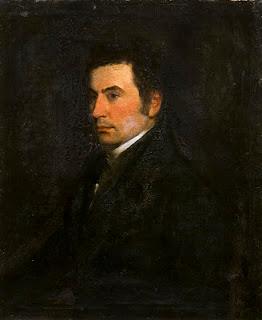
JM Davis, portrait of Thomas Manning, c. 1805, oil on canvas, 76 x 63 cm. Royal Asiatic Society of Great Britain and Ireland, via Wikimedia Commons. Public domain.
Thomas Manning arrived in Lhasa in 1811, after walking for months across the Himalayas from Calcutta, disguised as a Buddhist pilgrim and accompanied only by a Chinese servant, who spoke to him in Latin. He was the first Englishman to enter the city, the only person to do so in the entire nineteenth century, and the first European to meet the Dalai Lama, then still a child.
Among the Romantics, Manning was a friend of Charles Lamb, close to the mad poet Charles Lloyd, and friendly with Coleridge, Wordsworth, and Southey. He knew Tom Paine and Madame de Staël in Paris, and was considered a handsome charmer in her aristocratic and intellectual salons. He spent twelve years in China, India, Vietnam, and Malaysia, and was assigned as a freelance translator on Lord Amherst’s disastrous expedition to Peking, who was expelled from the Forbidden City after one day, because Amherst refused to “bow” to the emperor. He was probably the greatest English Sinologist of his time, before Sinology existed in England, and was the only one for most of this century who was not a missionary or religiously motivated. As an undergraduate, he wrote a two-volume textbook on algebra. It is said that he spoke fifteen languages. He was anti-colonialist and anti-clerical, expelled from Cambridge for refusing to sign allegiance to the Church of England. In Asia, he lived alone as a poor scholar, not working for the British government or the East India Company, whose functionaries he found annoying. He was renowned in the regions for his erudition, his self-made “Oriental” clothing of silk robes and turbans, and his waist-length beard.
Lamb wrote that Manning was “A Man of great Power—almost like a charmer. Far beyond Coleridge or any man who has the power to impress— … I know of no man of genius equal to him.” Thomas Allsop, a pupil of Coleridge and later a close friend of Karl Marx, said, “I can by no means convey any idea or even an adequate idea of its extraordinary and very strange power.”
Manning left no trace of this power. He wrote several memorable poems and an academic article on Chinese jokes, translating some forty poems in a deadpan manner. His letters to Lamb mostly contain puns and second-rate jokes, often about drinking. One of his extensive writings is a journal he kept on his journey to Tibet and back, published decades after his death, in the words of the journal’s editors from the Geographic Society, a curious “relic.”
The journal is notable for its almost total absence of observations about things that Westerners first saw. The splendor of the Himalayas is beyond mention. He had no interest in Tibet, which he considered only a back door through which he could enter China, which was then forbidden to foreigners. In the months he had been there, he had only reluctantly visited a temple once. He enjoyed going to the Potala to frolic with the Dalai Lama – who died at the age of ten a few years later – and otherwise amused himself by writing homophonic translations of Latin squibs. In the journal, he is barely aware of his surroundings, preoccupied with his clothes, his comfort, his health, his food, his sleep, the inferior quality of the local liquor, his disputes with his servants, and the maintenance of his beard. On the historic day when he finally reached Lhasa, his journal entry began: “Our first concern was to provide ourselves with a proper hat.”
His maid from China was arrested by the authorities. Manning was not allowed to enter China and was expelled from Tibet. He walked back to Calcutta alone. On his way home, he survived a shipwreck in the Java Sea and was stranded on an uninhabited island. Finally gaining passage on a second ship, together with the orangutan, he stopped to visit Napoleon on Saint Helena. He spent his last decades as a recluse in the English countryside in an unfurnished house, still dressed like an Oriental, his long beard now white, willing to answer letters with specific philological questions about China, but no longer in touch with his old friends.
At the time of his death, he left no manuscripts unfinished. Lamb lamented that Manning “will leave the world with no one but me knowing what a remarkable creature he was.” In 1844, critic William Bodham Donne wrote: “China Manning…one of the most remarkable men of his age, was unfortunately one of them [Adrien] Baillet might have included ‘educated people’ in his list intended to write something.’”
Eliot Weinberger’s Tu Fu’s Life published by New Directions in spring 2024. His Essay Art interview appeared in issue no. 253.
News
Berita Teknologi
Berita Olahraga
Sports news
sports
Motivation
football prediction
technology
Berita Technologi
Berita Terkini
Tempat Wisata
News Flash
Football
Gaming
Game News
Gamers
Jasa Artikel
Jasa Backlink
Agen234
Agen234
Agen234
Resep
Download Film
Gaming center adalah sebuah tempat atau fasilitas yang menyediakan berbagai perangkat dan layanan untuk bermain video game, baik di PC, konsol, maupun mesin arcade. Gaming center ini bisa dikunjungi oleh siapa saja yang ingin bermain game secara individu atau bersama teman-teman. Beberapa gaming center juga sering digunakan sebagai lokasi turnamen game atau esports.